Subterranean termites represent the most structurally destructive wood-destroying organism in Central Ohio. Eastern subterranean termites thrive in moisture-retaining clay soils across Franklin County, establishing…
Subterranean termites represent the most structurally destructive wood-destroying organism in Central Ohio. Eastern subterranean termites thrive in moisture-retaining clay soils across Franklin County, establishing underground central colonies that excavate shelter tubes over concrete masonry units and poured foundations. In established neighborhoods such as Clintonville, Victorian Village, and Grandview Heights, historic framing rests directly on masonry foundations where high sub-slab humidity accelerates wood softening. When these structural timbers absorb groundwater through capillary action, subterranean foragers establish continuous feeding lines, hollowing load-bearing studs from the inside out while leaving external paint layers intact. Understanding the distinction between subterranean termites and drywood termites is vital for property owners: subterranean colonies maintain continuous contact with subterranean moisture through mud tubes, whereas drywood varieties live entirely inside timber framing without requiring ground contact. Addressing subterranean species demands structural barriers placed at the soil-foundation interface rather than localized aerial spot spraying.
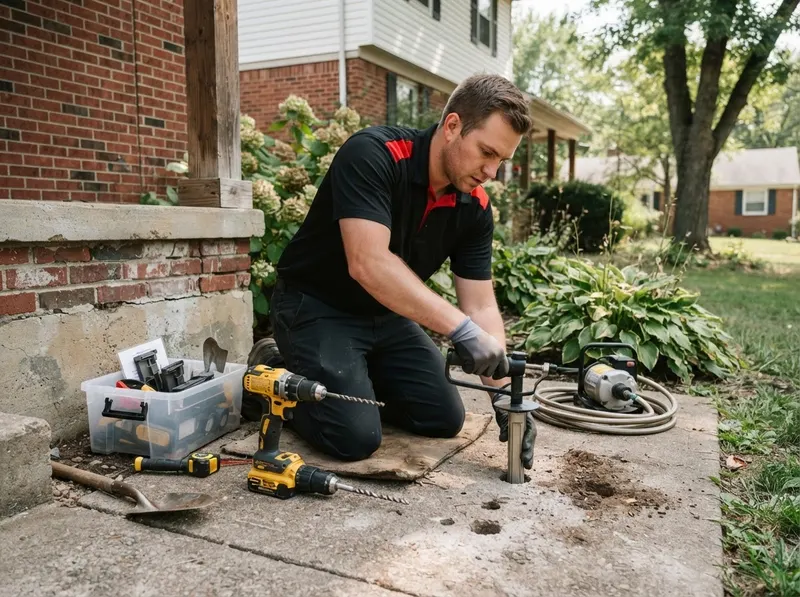
Effective defense requires an architectural exclusion protocol rather than temporary surface measures. Modern subterranean termite remediation combines non-repellent termiticide perimeter treatments with perimeter bait monitoring technology, adhering to environmental guidelines established by the US EPA and pest management standards from the National Pest Management Association. Liquid applications introduce systemic compounds into a continuous 6-inch by 6-inch trench along structural perimeters. Forager termites pass through treated zones undetected, transferring active ingredients back to reproductive queens through social grooming and trophallaxis, aligning with biological management principles documented by OSU Extension. In areas with dense slab architecture like German Village, Short North Arts District, or slab-on-grade additions in Upper Arlington and Bexley, remediation protocols incorporate precision sub-slab rod injection. Technicians drill discreet 0.5-inch ports through concrete porches and expansion joints at 12-inch intervals to inject protective materials directly beneath load-bearing slabs, sealing entry paths against future colonies.
Treatment selection balances immediate barrier integrity with environmental preservation. High-density baiting systems, deployed according to specifications registered with the Ohio Department of Agriculture, utilize subterranean monitoring cylinders containing chitin synthesis inhibitors. These cellulose matrices disrupt worker molting cycles without distributing liquid chemicals near private wells, cisterns, or sensitive riparian zones along the Scioto River corridor. While localized spot treatments address immediate active infestations in isolated floor joists, comprehensive barrier trenching remains the standard protocol for whole-home preservation. Every treatment strategy implemented by WillowForge Pest Care prioritizes domestic safety: products cure into stable soil bonds within two to four hours, neutralizing risks to indoor pets and children once dry while securing framing against structural degradation. In properties across Franklinton, Olde Towne East, and Worthington Hills, technicians verify moisture thresholds using precision electronic pin meters, identifying foundation cracks or plumbing leaks that contribute to pest vulnerability and advising on physical modifications to sustain protective barriers over multi-year spans.
Every job gets a firm, written price after a free on-site visit.
Tell us about your subterranean termite remediation job in Columbus and we'll send a clear, written quote, usually the same day.
 WillowForge Pest Care